Saturday, February 17, 2007

One Year Baby


Tomorrow will be the first anniversary of my marriage to Laurie. We often comment to one another that it feels like we've been married longer. Not that it's been a long year. I just find it difficult to remember what life was like without her. In all honesty I haven't really spent any time dwelling on it at all. Sure, I had some good times as a single guy, but I don't miss any of them.

If I feel anything, I feel richer. More balanced. Instead of being a solitary object hurtling through space, I now enjoy the gravity of another body. We are our own small solar system traveling through space and time in orbit around one another. Maybe its a silly analogy, but its the only suitable description I can come up with without becoming horribly maudlin.

We marked the advent of our anniversary with a wonderful extended weekend in Chicago. It truly was one to remember. From the incredible 57th floor condo we had overlooking the city to the amazing dinner at La Scarola, we had a blast. Laurie has already detailed it all in her blog, so head over there if you want to learn more.

While we were up there I spent just about every free moment I had trying to finish Crime and Punishment. I succeeded on our last day there. It truly is a classic. The setting may have been 19th century St. Petersburg, but Dostoyevsky's description of the human condition is still relevant today. While many may dismiss his overtly Christian point of view, I think you'd be hard pressed to say he didn't know what makes man tick.

I've Netflixed a 1969 Russian adaptation of the story that, by many accounts, is considered to be the most faithful despite the Soviet atheism that taints some of the screenplay. Like the novel, it's supposed to be pretty slow in spots. Still I look forward to hearing the characters speak in Russian. One of the frustrating things about being an English-speaking fan of Russian literature is that everything available to you is a translation. It always leaves you wondering how far from the real sentiments of the author your translator has taken you. Maybe I just need to quit complaining and take Russian. Or run knitting needles through my nipples. I hear both are equally painful.

Sunday, February 04, 2007

The Bitter End

Do you think Rex has been taken to a secret location to protect his throat from Urlacher's ringless fingers? Then again, Tank Johnson might be the bigger threat. He's on his way to prison anyway. Might as well go a hero.

Though they'll never read this, I raise a glass to the Bears defense. They are warriors. They played more minutes than any other Super Bowl defensive squad since the '85 New England Patriots and kept the Bears within striking distance all the way into the 4th quarter. They have nothing to be ashamed of. Did you hear that Boomer!?! Nothing. Let's see you play almost four entire quarters of football and stay at the top your game, you frickin' has been.

Finally, thanks to Deadspin for cheering me up a little with this.

Sunday, January 28, 2007

Ethanol: The SDI of Energy Policy?

Cruising Free Republic today I came across a link to this NYT article detailing Saudi plans to "temper" the price of oil. This is hot on the heels of the President's State of the Union address which highlighted a renewed US resolve to find alternative fuel solutions, the most promising of which is ethanol. I've also noticed a lot more stories about the increased production of ethanol in the last two years. The problem is, ethanol, for all its promise, is still a long away from being a viable alternative. Some of the very real and potential problems are reviewed in this editorial that appeared in the WSJ this weekend.

The story about the Saudis interest in moderating prices combined with all the hoopla over ethanol got me thinking--could ethanol be the Star Wars Defense Initiative of energy policy? For decades the Soviets relied on their ballistic missiles to keep the US in check. Reagan said the US was going to make them obsolete with SDI. The fact that SDI had yet to be proven a viable defense system, was irrelevant. The Soviets knew if anyone could pull it off, the US could. They also knew if Reagan said he was going to do something, they had to take it seriously. I also bet we let enough intel "slip" into their hands that they had to believe we were working in earnest. We all know how the story ends. The Soviets bankrupted themselves in an effort to keep up.

For decades the Saudi's and other totalitarian regimes have relied on their oil reserves to influence US and European policy in their favor. And up until the last decade or so, the US hasn't shown a ton of resolve to find alternatives to oil. But with so much government money being thrown at ethanol, I can't help but see a parallel to SDI. We may not have perfercted the use of ethanol just yet, but we can grow enough corn to keep trying until we do. I think the Saudi's see this and might be hedging their bets a little.

I'm not saying we should abandon alternative fuel research even if they drop the price per barrel to $1.05. Just as we shouldn't abandon development of technology that will make ballistic missiles obsolete. Any technological advance (or bluff) is worth the price if in addition to making life better, it puts despotic regimes out of business.

Saturday, January 27, 2007

Punishment


Currently I'm plowing my way through Crime and Punishment. And I think 'plowing' is an appropriate description here. Dostoyevsky certainly took his sweet time setting up the plot. I'm not saying I'm growing bored with the book, but I did catch myself thinking as I read one passage today, "Get to the point!"

I am not proud of this. It's more of a confession. As someone who writes for a living, I probably tend to venerate literary giants more than most. When I think things like that, I get much the same sense of dread I used to get as a kid when I'd mutter something rebelious under my breath and thought mom and dad might have heard me. It was like Dostoyevsky was standing over my shoulder, asking, "What was that young man?"

Ironically, one of the reasons I've wanted to read the book is precisely because of the painstaking detail in which Dostoyevsky told his stories. Another is that Crime and Punishment is considered by some to be a brilliant indictment of elitism. And I'm more than a little interested in how Dostoyevsky's faith shaped his writing. I guess today just reminded me that, as with any worthwhile endeavor, a certain amount dicipline is going to be required on my part to see this through.

In other news, Laurie learned Wednesday that she got the social studies curriculum coordinator job she'd been interviewing for. It's a big step up for her and one that could help her reach some of her long term career goals. She's already blogged about it, so I won't steal any more of her thunder. You can read about it here.

Monday, January 22, 2007

One Born Every Minute--Result

Just a quick followup to a post from about five months ago--

Back in June I related a story about an encounter I had with one of those door-to-door magazine salesman. Actually he was more of a saleskid, much like the Orlando Jones character in Office Space. You can read about it here. For those of you who recall, or prefer the Cliff notes version to reading the whole story, I was fairly certain I'd been scammed. I wasn't.

I've been receiving issues of Flying since October. I have no clue why it took so long but I hope the kid earned the trip to the Bahamas that he was gunning for.

Thursday, January 18, 2007

Longitude


"With God's help it might be possible. --I mean, why did He encourage me to build a perfect timepiece in the first place? So the blacksmith might start work 5 seconds earlier or later? Or was it to give us the ability to explore His creation in safety, to move without fear in the space He's given us to inhabit?"

So says John Harrison, as portrayed by Michael Gambon, in A&E's brilliant adaptation of the book Longitude by Dava Sobel.

A few summers ago while attending a wedding in Aspen I stumbled across a paperback copy of Longitude while killing time in a small bookstore. I think I'd seen a preview for the A&E movie and that's why I bought it. In any case, I remember walking out of the bookstore, sitting down on a park bench and being totally absorbed for about 2 hours straight.

The book is about one of the most significant scientific advances in human history--the ability to determine longitude at sea using specially designed clocks invented by John Harrison. Up until the 18th century, sailors of all nations were able to accurately determine latitude using celestial navigation. There was, however, no reliable way to determine longitude. This made sailing on the open seas, out of sight of land, an extremely risky venture. We're all familiar with stories of sailors perishing in storms or sea battles. According to Longitude the losses from such perils were rivaled by the numbers of mariners who, attempting to cross the open sea, simply got lost and never saw land again. Or if they did find land, it wasn't usually where they were headed, as in the case of Columbus.

Every monarch and parliament of the time that engaged in trade and exploration knew that the first nation to devise a way to accurately determine longitude would rule the seas. Their naval and merchant fleets would be able to move about the globe at will exploring, plundering and/or conquering it. This is why in 1714 British Parliament passed the Longitude Act that promised 20,000 Pounds to the first of Her Majesty's subjects who could solve the problem. That John Harrison, a common carpenter and not a noted scientist of the day, solved the problem makes this story even more engrossing for me.

Without going into a ton of detail, Harrison (and many others) knew that if sailors could accurately compare London time with a noon sighting of the sun at sea, they could figure out longitude. The problem was clocks of the time were not suited for life at sea and would not keep consistent time. Temperatures and moisture effected the metals and the ships motion effected the pendulums. When you consider a difference of 30 seconds could translate into hundreds of miles difference in location it's easy to see why this was a problem. Harrison's ingenius clocks were able to keep consistent time in all conditions.

If you get a chance, Netflix this one. I still haven't finished the book, but this movie has all but assured I will now.


Wednesday, December 27, 2006

Long Winter's Night

About the only daylight I see these days is on the drive to work in the morning and at lunch. By 5 it looks and feels like 9 or 10. Makes for a slight malaise. Thankfully there's Netflix, Esquire and Sam Smith's Winter Welcome.

I'm watching Pump Up the Volume right now. It's about blogging basically, only with short wave radios. And there are a lot more people listening than there are talking. Can you tell I'm reaching for crap to write about?

On a final note, I saw Night at the Museum with my nieces last night. Not bad. Not bad at all. It was a great fairy tale that actually might get a kid or two a little more interested in history. See it on the big screen if you can. And for those who love her, NY City plays a great supporting role.

Saturday, December 02, 2006

What the . . . Cheeseburger's Movie Kung Fu is Better Than Mine?!?

While 74% sounds about right for me, I think this quiz is a little off because it gave Cheeseburger a higher movie buff score than McKee or I. She couldn't even sit through 20 minutes of Airport. If memory serves it was "too slow". Anyway, next time I'm up her way I'm challenging her to a movie trivia contest. We'll see who the real movie buff is. If you take the quiz let me know what your score is. It really is kind of fun, if not a little specious.

My Movie Buff Quotient: 74%
According to this, I am a total movie buff. Classics, blockbusters, indie favorites... I've seen most of them.
My friends know to come to me whenever they need a few good DVD rental suggestions.

Saturday, November 18, 2006

Open to Interpretation

I had a weird dream last night. I was watching a commercial with all these comedians pitching some product which I can't remember. Eugene Levy, Steve Martin and Richard Lewis were the only ones I distinctly remember. The commercial was like a Docker's commercial where everything is supposedly ad lib and the guys are all kind of riffing of each other and laughing like they're just hanging out.

Now for the weird stuff. They were all wearing Docker's-like apparel and Steve Martin had a 2 foot long mullet. Levy's hair seemed a little grayer than normal. Sometimes I was in the studio with them and sometimes I was on the other side of the TV screen watching them. Can anyone tell me what this means?

If it aids your analysis, I had just had a big meal of chicken cacciatore and 1/2 a caraffe of chianti at Dom's. I was still feeling a little bloated when I went to bed.

Wednesday, November 08, 2006

Happy Now?

I’ll admit it. I’m disappointed, but I’m hardly despondent. Sure, as anyone who knows me will attest, I have fairly distinct political convictions, which I’ve been known to spout on occasion. But I’ve never really pinned my prospects for the future on who was in office. The way I see it, the federal government can certainly affect your life, but until things drastically change, America is still a place where life is yours to ruin.

Besides, not much is probably going to change in the next two years other than committee chairs. Democrats have a one or two seat margin in the Senate and a 20 something seat advantage in the House. Many, if not most, of the Republicans that lost their seats were moderates. It’s unlikely that a more conservative Republican minority, a sizable number of which think even Bush is too liberal, will be in a very bipartisan mood. I also doubt the incoming majority leadership possesses the requisite influence to ensure all Democrats vote the party line, let alone convince Republicans to join them.

About the only real prospect we have for change is impeachment. And as I've said here before, I sincerely hope the Democrats go for it, but they won't. And not because they don’t have the votes for it, although that will probably be the excuse given to the rabid left that seems to comprise their base now. I’m guessing Harry and Nancy will be too busy shoring up power for the ’08 election to do anything principled (i.e. politically risky). Much safer to snipe at a lame duck president from the safety of sound bites and "summits" than to have to testify under oath or meet any sort of real burden of proof.

No, it’s hardly 1994 all over again.

NOW FOR SOME GOOD NEWS FOR ALL OF US . . . .

The Daily Mail had a fairly exciting story (here) about a promising new treatment that uses a heart attack survivor's own stem cells to repair heart tissue. I know I’m dangerously close to another political hot button here, but I thought regardless of where you stood on the topic of stem cell research, this was good news for everybody.

Tuesday, October 24, 2006

Support the Art--See Last King

The Art Theater has once again proven its worth by bringing the The Last King of Scotland to town. Laurie and I, along with the Burai (plural for Buras), took it in last Friday. I'm not entirely sure how much of the movie is factual. It is based on a novel about a young Scottish doctor who was working in Uganda at a mission hospital where he by chance encounters Idi Amin and becomes his personal physician.

While the vast majority of critics are raving about Forest Whitaker's portrayal of Amin, and rightly so, it is the relatively unknown (to me anyway) James McAvoy that deserves no less credit for his turn as the young, narcissistic Dr. Nicholas Garrigan. Whether Garrigan actually existed or not, I'm not sure. There's no mention of him in the epilogue at the end of the film. But it is through his character that you are transported into Amin's inner circle and experience the seduction of absolute power firsthand.

I won't go much more into the film, but I will say this. For me it was as much about the naive arrogance of bumper sticker activism as it was about Amin's cruelty. This theme is particularly underscored in one of the film's harrowing final moments. But I won't drop any more hints. Go see it and see it at the Art so they can keep bringing great movies to this town.

Sunday, October 15, 2006

Simmer Down Dick

In my last post I made mention of know-nothing politicians over reacting--wait, over acting about the Lidle accident in New York. This week's best actor award goes to Dick Daley--or Emporer Daley as those familiar with his Meigs Field land grab like to refer to him. In a fit of hyperbole he loosed this gem, "They should not jeopardize, through intentionally or by accident, a single- or two-engine plane flying over our city [sic]." "Remember: a single- or two-engine plane can kill as many people as possible if they want to."

AOPA President, Phil Boyer, responded to Daley's ridiculous assertion in an article which you can read in its entirety here. Below, however, are the portions of the response that really get to the heart of how irrational so much of the demagoguery we've been subjected to in the last several days really is.

OK, for all of those ranting about "threats" from GA aircraft, we'll believe that you're really serious about controlling "threats" when you call for:

  • Banning all vans within cities. A small panel van was used in the first World Trade Center attack. The bomb, which weighed 1,500 pounds, killed six and injured 1,042.
  • Banning all box trucks from cities. Timothy McVeigh's rented Ryder truck carried a 5,000-pound bomb that killed 168 in Oklahoma City.
  • Banning all semi-trailer trucks. They can carry bombs weighing more than 50,000 pounds.
  • Banning newspapers on subways. That's how the terrorists hid packages of sarin nerve gas in the Tokyo subway system. They killed 12.
  • Banning backpacks on all buses and subways. That's how the terrorists got the bombs into the London subway system. They killed 52.
  • Banning all cell phones on trains. That's how they detonated the bombs in backpacks placed on commuter trains in Madrid. They killed 191.
  • Banning all small pleasure boats on public waterways. That's how terrorists attacked the USS Cole, killing 17.
  • Banning all heavy or bulky clothing in all public places. That's how suicide bombers hide their murderous charges. Thousands killed.

Number of people killed by a terrorist attack using a GA aircraft? Zero.

Number of people injured by a terrorist attack using a GA aircraft? Zero.

Property damage from a terrorist attack using a GA aircraft? None.

So be consistent in your logic. If you are dead set on restricting a personal transportation system that carries more passengers than any single airline, reaches more American cities than all the airlines combined, provides employment for 1.3 million American citizens and $160 billion in business "to protect the public," then restrict or control every other transportation system that the terrorists have demonstrated they can use to kill.

Don't worry, Phil. They probably will.

(Yeah, I did that on purpose)

Thursday, October 12, 2006

Much Ado About Lidle

Ever since Eric Lidle earned his place in aviation history yesterday, I've had more than one person ask me what I thought happened. At first it sounded like a typical VFR into IFR scenario-- inexperienced pilot without an instrument rating suddenly finds himself in the clouds and gets disoriented. Also referred to as the JFK Jr. scenario. Tonight, however, I came across this story which sheds a little more light on what happened. It also happens to be the most balanced, unsensationalistic analysis of a high profile aviation accident I've ever seen in the mainstream media.

The aircraft that Mr. Lidle was piloting was a 2002 Cirrus SR-20. Except for some instrumentation differences, this is the exact same airplane I fly. The only really troubling aspect of this whole incident for me, besides the inevitable over reaction by know-nothing politicians, was the fact an instructor was in the cockpit with Lidle. It just makes the whole tragedy seem that much more needless than it already was.

I was going to write about the many inaccuracies being reported by the media regarding this incident, but they are so many it's pointless to even try. There is one widely reported, oft repeated fallacy, however, that I will address. Contrary to what many news stories are saying, light aircraft flying up and down the Hudson or East Rivers do talk to ATC if they are below 1,100 feet. The charts I have for the New York metro area clearly state "although arriving aircraft may be operating beneath the floor of class B airspace on initial contact, communications should be established with approach control" whether they've filed a flight plan or not. They also indicate VFR aircraft operating below 2000 feet in the vicinity of where Lidle crashed need to contact La Guardia or JFK control towers.

Still, I can understand how many non-pilots might wonder why the FAA has allowed small aircraft to continue to fly so close to Manhattan with relatively light supervision. The answer is simple. A light private aircraft does not pose a serious threat as a weapon of mass destruction. The payloads are too small to carry any amount of explosives that could do serious damage and their slight mass and relatively slow airspeeds make them poor projectiles. Also, private airplane operaters know their passengers and cargo making the probability of a hijacking slim to none. Plus, it's very difficult to "blend in" at a small airport. AOPA's Airport Watch program has gone a long way into helping the smaller out-of-the-way airports tighten security.

All that said, it still doesn't change the fact that the biggest challenge to the public's perception of private aviation is not an ignorant press corp, but the errant pilots who give them something to talk about now and then.

Sunday, October 08, 2006

I'm Sorry Bernie

Back in ’93 when I was working toward my private pilot license, I had a particularly difficult stage check instructor named Bernie. The school where I was receiving instruction was what was called a Part 141 school. Basically this meant the school was operated under Part 141 of the Federal Aviation Regulations.

Under Part 141 a school is to maintain a 3-stage, FAA approved syllabus. At the end of each stage the student is given, what is in essence, a mini check ride by a stage check instructor other than his regular instructor. If you don’t pass a stage exam, it is back to the previous stage for remedial instruction. Stage II was the flying school equivalent of a midterm.

My first stage exam had been a breeze and I was completely confident in my abilities to ace stage II. When it came time to set up the stage II my assigned instructor at the time (I ended up going through about 3 of them—that’s another story) told me in a somewhat somber tone I’d be flying with Bernie. He said, “Bernie has a reputation for being pretty tough, but I think he’s fair.” I think he’s fair? Some instructors didn’t? Still I wasn’t too worried. I knew my stuff and could demonstrate it at the controls. I was sure I’d be fine.

I’d never met Bernie before. I’d seen him around the airport, but I had no idea he was one of the instructors, let alone one of the all-powerful stage check instructors. He was in his late 60’s early 70’s and was often seen buzzing around the airport in an old Stearman. I’d never met an old pilot I didn’t like. Old pilots were generally pretty mellow and full of aeronautical wisdom from thousands of hours of flying through every kind of sky imaginable. I would liken them to Tolkien’s ents. I expected Bernie would be the same way.

The day of the stage II exam arrived and the two hour ordeal started in the basement classroom of the school with an oral exam. Bernie sat silently across from me hunched over my folder looking for weaknesses. The first question out of his mouth was less spoken than barked. I can’t remember what it was, but I remember being so surprised by the delivery I totally blanked. Bernie glowered at me from behind his glasses, “Well?!? Don’t you know this stuff?” Eventually I coaxed a reply from my frozen larynx.

The rest of the oral went OK as far as I can recall but any confidence I’d had going in was gone, or at least critically wounded. Every answer I gave, whether right or wrong, was greeted with the same disdainful glare. The idea I was going to have to spend an hour in a cramped 152 cockpit with this guy filled me with dread. For the first time in my instruction, I was afraid I wasn’t going to pass.

The flight portion was a near disaster. The same hostility I’d faced during the oral just seemed to be magnified by the tight space of the cockpit. A couple of times when he asked me to demonstrate a maneuver he would yank the controls away from me, practically screaming at me that I didn’t know what I was doing. My anxiety slowly morphed into anger. I’d always been raised to respect my elders, but this guy was being a grade A ass and I didn’t care how old he was or how much experience he had. He was making me uncomfortable and I was certain he was getting a charge out of doing so. By the end of the flight I hated him.

Despite that flight with Bernie I went on to finish my training and obtain my private pilot license. And with the passing of the final check ride, so passed most of my animus toward Bernie. Once I had the ticket there was nothing he could do about it. I’d see him now and then around the airport, but I still resented him enough that I wouldn’t ever talk to him unless I had to.

That was 13 years ago. A couple of days ago, I saw Bernie again while eating lunch. His wife, every bit the saint I imagined she had to be, gently led his emaciated frame to the table right next to ours and helped him into his chair. She spoke softly to him, “We’re going to have some soup and some nice hot tea, OK?” Bernie simply stared straight ahead, his mouth agape, in the frozen grimace of dementia. His wife caught me staring and smiled sweetly. I weakly returned her smile and looked away. But when I went to pay my bill, I looked at Bernie again and the improbable happened. I started to get choked up.

I felt ashamed for the terrible thoughts I’d had and things I’d said right after that exam over a decade ago. I remember bitterly complaining to my instructor about the “demented old man”. I remember wanting to strike him when he suddenly yanked the controls away from me during an approach, yelling at me as if I was some kind of idiot. Most of all, I was heartbroken at the prospect that a lifetime of flying memories were lost forever. I sincerely pray that wherever Bernie is behind that vacant stare, it’s in the cockpit of his Stearman flying over Central Illinois through a crystal blue autumn sky.

Thursday, September 28, 2006

We were just another couple out of Boston . . .

It’s been a while. Like many of you I’ve been busy living life while making other plans. Last weekend, though, Laurie and I were really living. We flew ourselves out to Boston for the wedding of one of her teaching pals from her Whitinsville, MA days. It gave me a chance to rack up some quality cross country hours at the controls of N218DF and gave Laurie a chance to reconnect with some very dear friends.
The plan was to leave Friday morning, but the rapid advance of a monster low pressure system bearing every conceivable hazard to a light airplane forced us to leave late Thursday night. Unfortunately, a parent teacher meeting obligated us to wait until 8 pm CST to leave. We were also going to be losing an hour shortly after crossing into Ohio, meaning there would be few fueling options open to us. We ended up holing up for the night in Youngstown, OH.
     After a 7 hour nap and a nice complimentary breakfast, we departed Youngstown around 10 with the storm we’d fled in Champaign now menacing us from just across the border of Indiana. Winds were favorable and we touched down in Worcester about 12:30 that afternoon under gorgeous late September skies. During the flight I noticed the rapidity and terseness with which air traffic controllers speak increases steadily the closer you get to the eastern seaboard. It’s hardly surprising when you consider the Philly/Boston/NY metroplex is probably the busiest patch of airspace in the country. You’d better know your stuff and be Johnny on the spot with an immediate readback or you could literally be told to go back from whence you came.
     Once we were on the ground it was Laurie’s turn to drive. “Massatushits”, as she fondly refers to it, is her stomping grounds so I deferred to her on where we went and what we did. Before we got to her friends’ house in Uxbridge, where we were to stay, she took me to Providence, RI and Apsara—home of the finest Thai food I’ve ever had. Laurie had often raved about the place during reminiscences of her wild days as a hot, single school teacher in rural Mass, so it was cool to see one of her old hang outs and stuff myself with Nime Chow in the process.
     From there we drove to Uxbridge and met up with her friends Bob and Linda who were gracious enough to give us a spare bedroom as a crash pad while we were in town. Laurie also taught with Linda. Bob was on the school board when she was hired. Both were at our wedding and both are a lot of fun to hang out with.
     The wedding was Saturday in the Park Street Church right on the Boston Common. Laurie and I got there a little late but before the ceremony started. The church, which dates back to 1809, is fascinating. It sits on the site of the Old Granary Building of 1728 in which the sails for the USS Constitution were sewn. Among the many 300 year old memorials planted in the cemetery next to the church are stones dedicated to John Hancock, Samuel Adams and Ben Franklin’s parents.
     The reception was in the Langham Hotel just a few blocks away from the church. Laurie and I walked to it as the rain Boston was supposed to get never materialized. It was kind of cool to walk through city all dressed up like we were. Naturally Laurie looked awesome and I found myself simultaneously amused and annoyed by the admiring glances she was getting from doormen and other guys on the sidewalk. I couldn’t really blame them, though. I notice many of the same glances anytime we’re gussied up for a night on the town in Chicago. She’s a city girl at heart and when she’s dressed to the nines in a town she loves, she’s hard to miss.
     Sunday we hooked up with my cousin Bob, his wife Liz and their girls for more Beantown fun. We had lunch with them then spent the afternoon exploring the city on our own while they went to a matinee of 1776. Boston really isn’t that big of a big city, so it doesn’t take long to explore it on foot. We roamed from the Back Bay to the South End and then back up to the Common and Beacon Hill. While we were in Beacon Hill we sojourned for an hour or two in Emmit’s Pub at a table with windows that opened out to the street. Later, we rendezvoused with Bob and Liz one more time for dinner at a place called Joe’s on the water next to Christopher Columbus Park.
     By the time we got back to Uxbridge it was only about 11:00, but we were both wiped out. The next morning we departed Worcester under the same gorgeous skies we arrived with. The storm that had been chasing us passed while we were on the ground in Boston. But as a parting shot, it left some nasty headwinds in its wake. The trip back took 7 hours total. The leisurely pace, though, allowed as to spend more time looking out the windows at the more scenic parts of rural New York and Pennsylvania where we could see trees starting to turn.
     I hope to get a pic or two from the flight back posted as soon I get a card reader. (we lost the transfer cord to our camera). We were so busy having fun in Boston we forgot to take pictures.

Tuesday, September 05, 2006

Chicago, Chicago . . .

A link to some pics of Laurie and I on the town in high style at my cousin's wedding.

Saturday, August 26, 2006

I Am "Subject 12": A Test Pilot's Tale


About a week ago I got a call from someone at the U of I looking for test subjects for an interactive cognition study of pilots. The purpose was to see how pilots processed lengthy ATC (air traffic control) instructions and what aids were useful in remembering them. The kid--he couldn’t have been over 21--who conducted the tests was a psychology undergrad in his 2nd year. He reminded me a little of Data in the methodical, almost dispassionate way in which he administered the tests.

The tests were conducted over two, three hour sessions. The first was Thursday. Before the experimentation began I had to sign a waiver saying I understood the risks involved. About the only tangible risk was the slight possibility of damage to my retina from the infrared eye tracker they were going to be using to track my instrument scan in the simulator. This eye tracker was part of a larger piece of head gear that would also track my head movements as I looked around the cockpit. The whole contraption reminded me of something from a Terry Gilliam movie—sort of menacing looking but completely harmless.

The first portion of the experiment was kind of humiliating. It involved testing my vocabulary and memory. The vocabulary part I aced. The other part though made me feel like a senile old man. That part involved listening to a tape recording of a series of sentences. As soon as a sentence was spoken I had to indicate whether it was true or false. After that series of sentences was completed I had to say the last word of each sentence read to me. I did fine when there were no more than three sentences in series. But when they got up to four I couldn’t remember anything. At first I started making things up, but finally admitted I couldn’t remember. My examiner, as nice of a kid as he was, was almost entirely devoid of humor. Any time I tried to ease my embarrassment by joking around, he’d just silently stare at me as if I was a petri dish and continue the experiment.

Thankfully, that part of the experiment ended after about an hour and the fun stuff with the simulator started. The simulator was a Frasca 142 situated in this big room in the basement of the Beckman Institute. In front of it were three big 12’+ screens on which were projected the simulated world of Frasca. Unfortunately the simulated world of Frasca is stuck in early 1990’s VGA. My flying environment consisted of a flat green earth opposite blue sky with high cirrus clouds. You could probably achieve the same effects with the display on your cell phone.

In the sim, I was tested on my ability to hear and comply with ATC instructions under a variety of conditions. Basically the conditions were:
  • Copying ATC instructions using a kneeboard with paper and pad

  • Flying without any type of memory aid at all

  • Using an “MCP”—I don’t know what that was an acronym for, but it was a touch screen that let me tap in the heading, altitude and airspeed ATC instructed me to fly
I flew each of the three conditions in both smooth air and turbulent air. I had to readback all instructions as I would in real life and all my responses were recorded. While I was doing all this, the examiner would randomly introduce air traffic into the flying environment and I would have to say, “Traffic.” whenever I spotted it.

Every section of the test began with the examiner speaking into the voice recorder, “Subject 12, (condition).” I have to admit it gave me slight chill to be referred to as “Subject 12”. But that’s science I guess. I’m sure collating research data would be much more difficult if those listening to the recordings had to hear, “This is Larry. He’s an Aries who likes trees and enjoys autumn walks in the park. He’s recently been married and his favorite treat is peanut butter.”

On Thursday all we really did was a familiarization session with the simulator and the types of conditions I would be operating under. Today was the main part of the test in which I had to don the aforementioned eye/head movement tracker. Calibrating the eye tracker was exactly like the calibration sequence you usually encounter in video games like Halo. After he’d locked the infrared tracker onto my eye, he had me look at numbered locations on the instrument panel so he could “map” where I looked in the cockpit.

After about 2 ½ hours of "flying" with the tracker cinched down on my noggin, I was getting a sore neck and a slight headache. But I kept telling myself I was doing this for the good of aviators everywhere. I was the Chuck Yeager of interactive cognition and my contribution to science might very well save the lives of countless pilots in the future. The reality is, I’ve probably done nothing more than help put a slight dent in the incidence of air traffic controllers having to repeat themselves. Still, I had about a 1% chance of damaging my retina in the process. Hey, it’s not the same as strapping myself to an X-15, but I could very well have wound up needing a good squirt of Visine.

After I was done, Data paid me (a whopping $44 smackers) and I walked over to Murphy’s Pub and celebrated my exploits with my wife and a $7 pitcher of Leinie’s Sunset Wheat. Yeah, it feels good to be a gangsta'.

Finally, my wife surprised me with the news that we are now a family. Yes, she got me a fish. A spunky little Beta which I shall call Walter. Pictures forthcoming.

Tuesday, August 22, 2006

"Pee Wee Forgot to Pay"

So said the back of the diner check taped above the register at the Royal Waffle King in Somerset, KY. The Waffle King is a wonder of culinary delights, economy and service. Sandwiched between a Golden Corral (think Ponderosa) and a Sign-O-Rama on Kentucky state route 27, it offers breakfast and lunch fare 24 hours a day. And apparently the management has an understanding with Pee Wee.

Laurie and I stopped there to grab a bite on our way down to Cumberland Falls State Park. Tony, the guy at the Jamestown airport who gave us directions, said, “It’s a long way to drive just to see some falls. They ain’t nothin’ spectacular but I guess the drive’s nice.” That’s really all we were after anyway—a nice drive in the SSR with the top down. Incidentally, Tony, when not running the airport and subverting the state’s tourism industry, was an avid RC pilot. He had a Great Planes Lancair in the hangar with all the full-scale planes. He said in between chores he’d fire it up and fly it around. I don’t see why he shouldn’t. Not much goes on at the Jamestown airport on a hot and sticky Saturday afternoon outside of grass growing.

The drive was gorgeous. If you’ve never been down to this part of the country you should get over your redneck phobias and check it out. Many of the roads meander through beautiful forests and hewn bluffs. Waterfalls and creeks abound. And the folks, while certainly down home, are more hillbilly than redneck. To me a hillbilly is not the same as a redneck. Most hillbillies can read music and play an instrument and about the closest thing I’ve ever heard to a racial epithet was the term “colored person”. This is usually only used by the older set because to them that’s politically correct. At least it was back when the NAACP was founded. In fact, this trip I saw more integration in Somerset between hillbillies, Mexicans and African Americans than I do up here. In the rural areas like Somerset, there isn’t a “that side of town”. The towns aren’t big enough to segregate and people seem to get along fine.

Sure you see the occasional Confederate flag, but not nearly as many as you can see up here on the pickups in Lava’s parking lot on “18 and Over” night. Most of the people displaying them down there are out to tweak the noses of the white urbanite Yankees that only come down between Memorial Day and Labor Day to tear around the lake on their 50-foot 100mph speed boats—a demographic my Uncle Bobby affectionately refers to as, “The Ohio Navy”.

In fact, if you do decide to venture down there, don’t go until after Labor Day. That’s the time of year when there’s still the best part of the summer left and you can meditate on the gorgeous surroundings without the constant din of twin 500 cu in Chevy big blocks. This is when southern Kentucky is best viewed in its natural state. I wish I could fly all of you down at least once to see it.

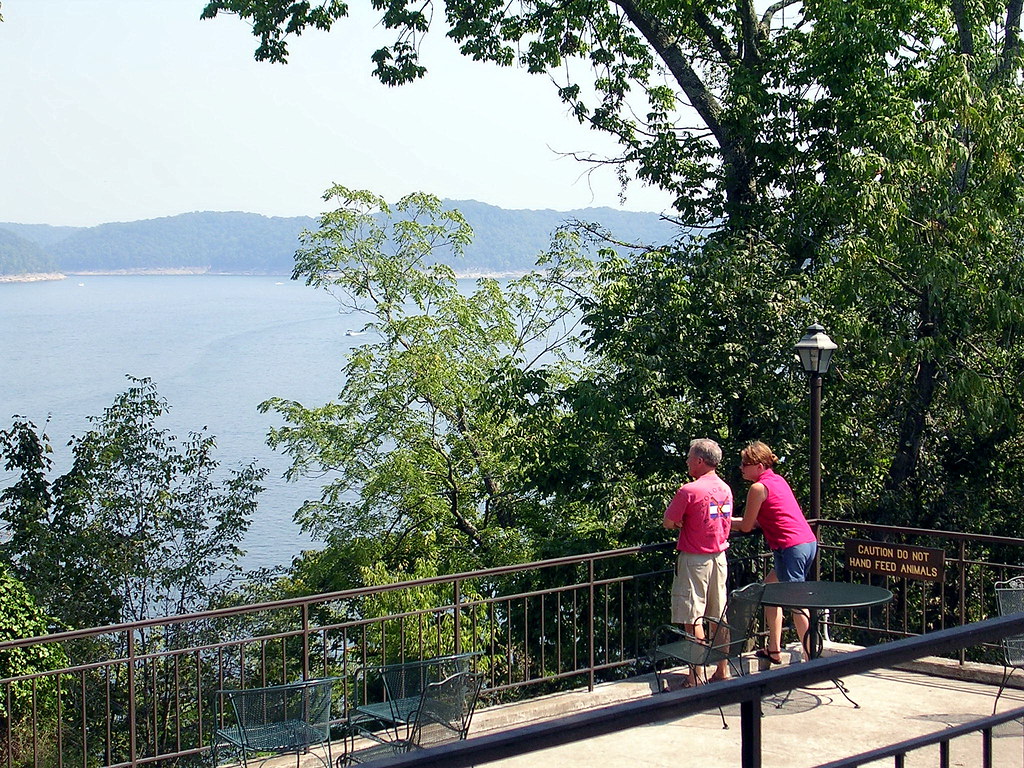
In lieu of actually transporting you there, however, you will have to settle for this photographic reminiscence from last summer. I would’ve took pictures this trip, but left the camera at home, as I usually do when I go somewhere interesting. I sometimes wonder why I even bought it.

Thursday, August 17, 2006

Seeegars

For my fellow cigar aficionados I've added a "FUMAR UNDER $5" section to the index--my survery of cigars under $5*. As with the FLICKS section, the list will be limited to six at a time with the most recently enjoyed smoke at the top. Where possible I will link to a picture of each smoke for easy reference the next time you visit your local tobaccanist.

*$5 before tax. Caution: Cigar smoking has been deemed a criminal activity by the People's Republic of California.

Tuesday, August 15, 2006

The Kobra

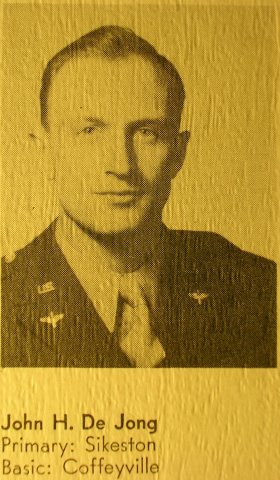
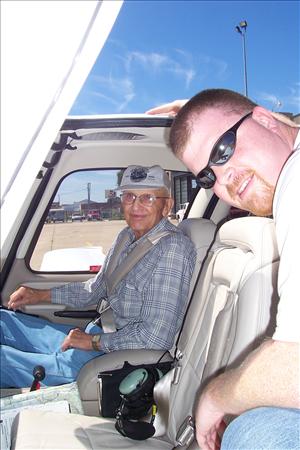
Last Saturday, I had the privilege of taking Laurie's Uncle John for a flight. Uncle John is 89 years old, and over the course of his life has assumed many mantles. Among these are husband, father, farmer, machinist and Kobra. As a pilot, it is the later that has always fascinated me ever since I met him.

You see, from 1944-1945 2nd Lt. John H. De Jong served as the co-pilot of a B-24J belonging to the 494th Bombardment Group, otherwise known as Kelley's Kobras. The group was so named after its commanding officer, Col. Laurence B. Kelley. Although the 494th didn't see action until late in the war, they played a major role in helping Macarthur's army bring the Japanese occupation of the Philippines to an end.

When John returned from the war he went back to working the family farm, but never quit flying. Every chance he got, he would rent a Cessna 172 and fly low over rural Indiana, occasionally buzzing his farmhands while they worked in the fields. Unfortunately, he had to stop flying altogether after being diagnosed with diabetes. Saturday's flight with me was his first in a light airplane in 25 years.

I'm serious when I say taking him up was a privilege. So many guys like him have followed their exploits into history. So few remain to tell their story. Before long they will all be gone and only the books will be left.